What happens in these manga series by creator Junji Ito is too disturbing to show. But the buildup leading up to these terrifying images is ideal for this article’s Halloween special.
In this post, I share observations about the master of horror as I render some of his iconic manga pieces in pen and ink.
Click the button below for this free manga sample (short stories).
This master has an incredible body of work, which I’ve linked in the resources section at the end of this article. You’ll also find a complete list of the art supplies I used for the featured studies.
//DISCLOSURE: I earn a small commission when you use my affiliate links to make a purchase. Visit the Terms Page to learn more about my affiliate partnerships.
The key takeaway
Getting right to it – the key takeaway – the thing that stood out about his work, is this:
It’s all about … contrast.
Junji Ito uses contrast as a storytelling tool. He does this in two ways:
- With his mark-making, and;
- with his subjects.
Junji Ito’s mark-making techniques
Let’s start with Junji Ito’s rendering and how it’s a psychologically powerful technique for storytelling.
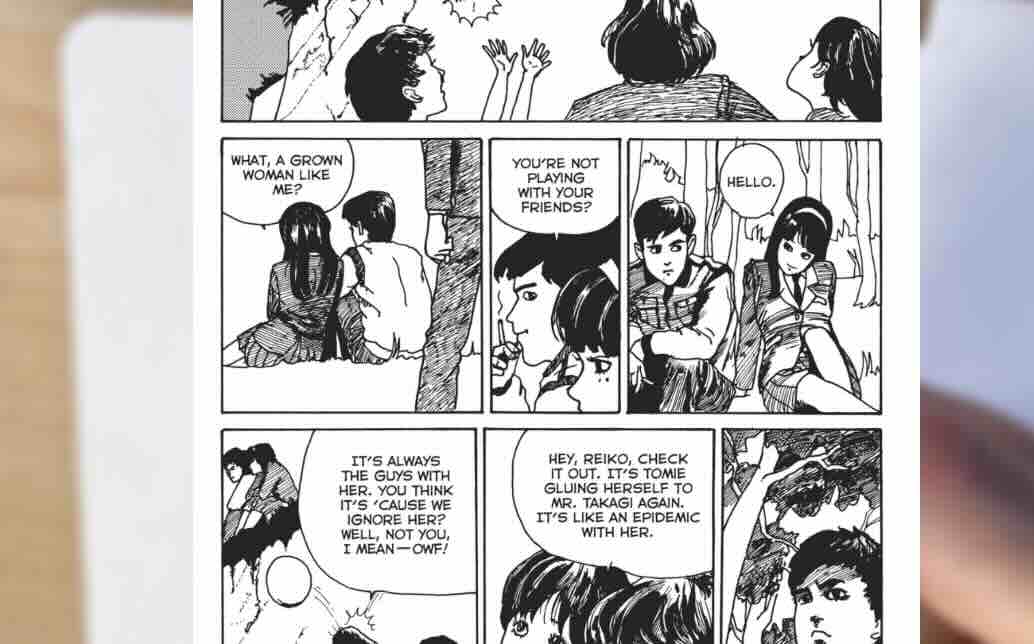
The opening panels of each manga follow the same formula.
We’re shown scenes and characters rendered in a minimalist, straightforward line work.
The marks are neat, controlled.
Essentially, there’s nothing out of the ordinary; it’s just a regular day like any other day for these characters, and the reader is led to believe that the classically rendered illustrations are simply there to establish the storyline.
But then, things start to look a little off.
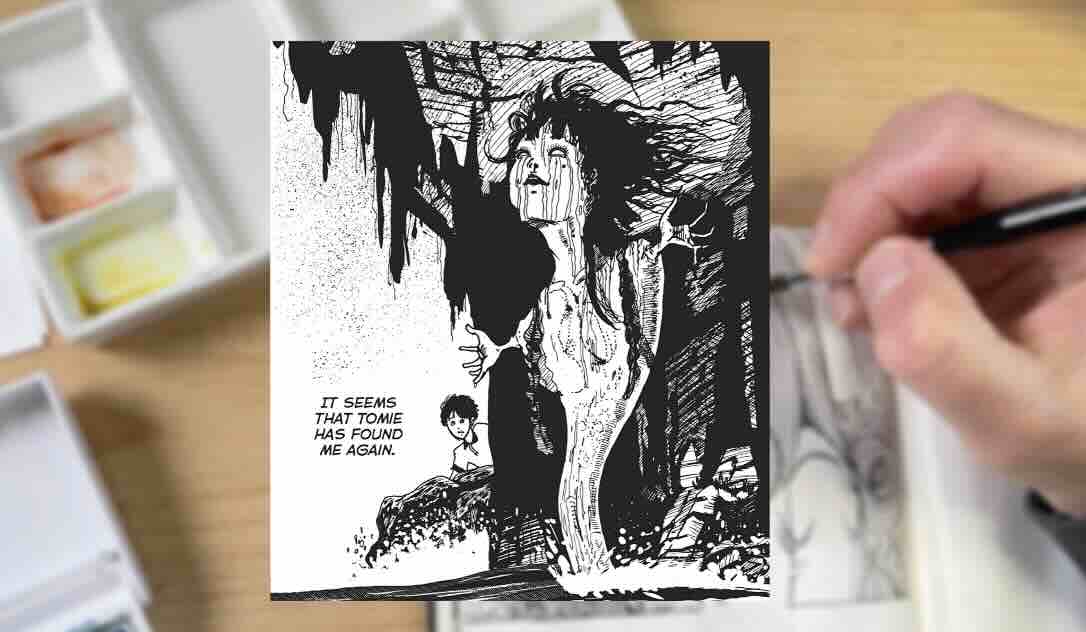
The marks become disorganized. The pace of the story quickens.
As tension rises, so does the stability of the hatch marks.
The creepier the story gets, the more panicked the hatching gets.
The master builds suspense in the story stroke by stroke. And it gets scary fast.
This thing the characters are looking at, pictured below, is monstrous. As is the hatching for that section (in a good way), where the tonal values descend into darkness.

Junji Ito’s subjects
And that brings us to the contrast in Junji Ito’s subjects, where beauty turns ugly.
Once again, he uses mark-making strokes to communicate a transformation from attractive to grotesque.
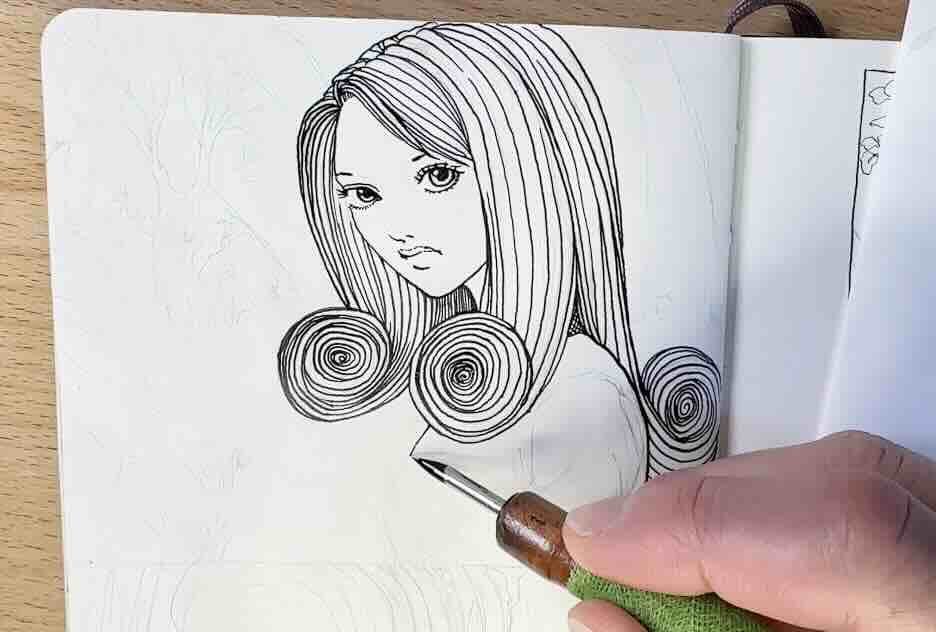
In the study below, I aimed to match the delicate, linear strokes to render the attractive girl. Using a fine nib; a Tachikawa soft Maru.
For the other study, I aimed to match the psychopathic hatching to render the grotesque girl. Using a flexible Tachikawa G-nib, best for dynamic, irregular effects.
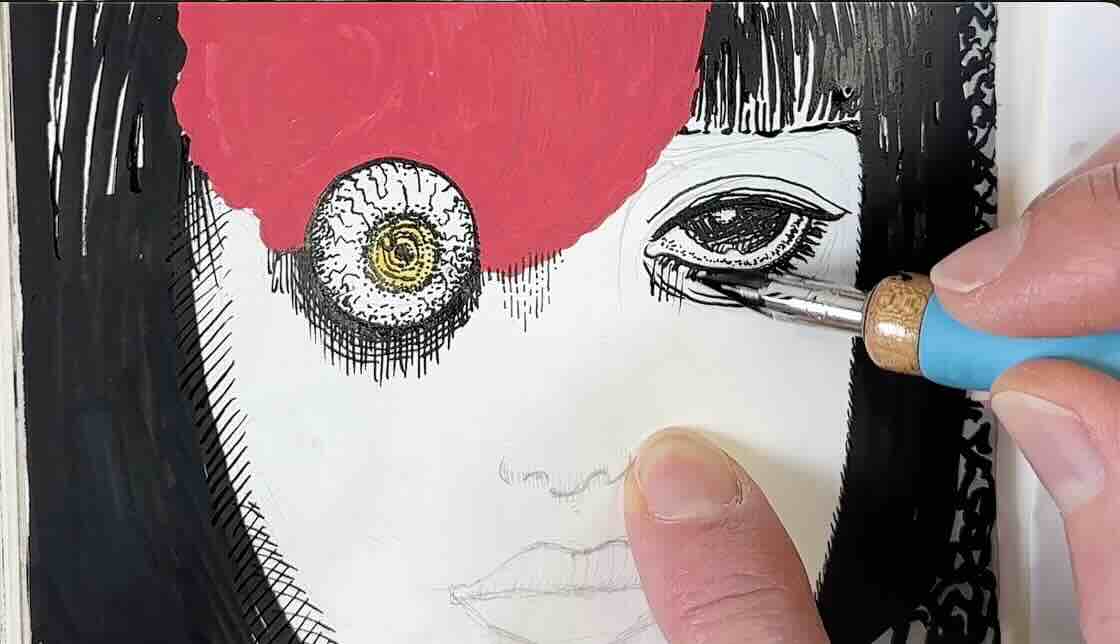
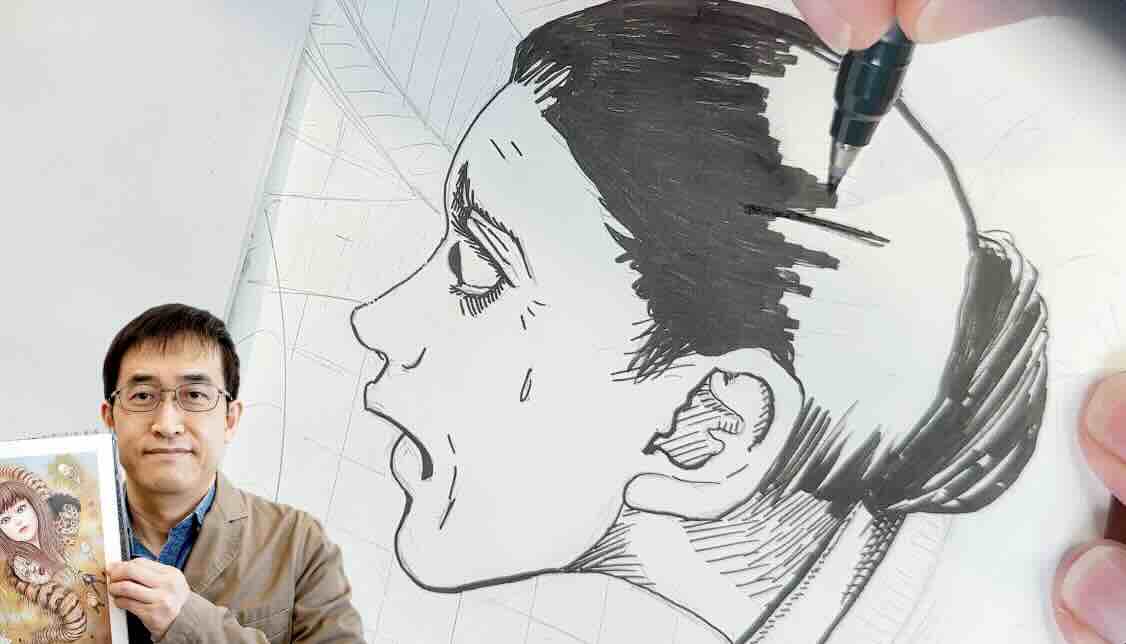
In the third study, I used Tombow sponge-tip brush pens to render the scene because it’s a turning point in this particular story.
These brush pens have a flexible tip, making them ideal for thin-to-thick lines in a single stroke. Plus, you can scribble vigorously without damaging anything.
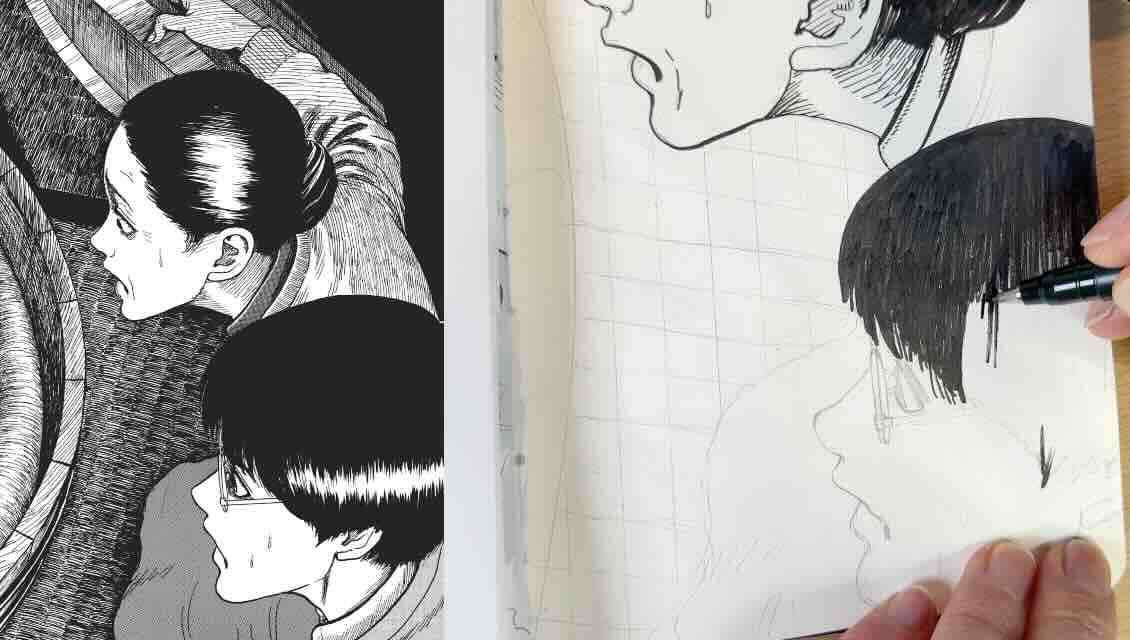
As mentioned earlier, the characters are looking at something unimaginable. They’re in shock. Terror is rising.
You just know, in the next panel, they’re going to lose their marbles.

The line work in this scene builds tension. It becomes progressively less polished for the characters, and the aggressive shading that engulfs them looks deranged.
Back to the pretty girl. Why is her face green? And those spiralling tresses, they look alive.
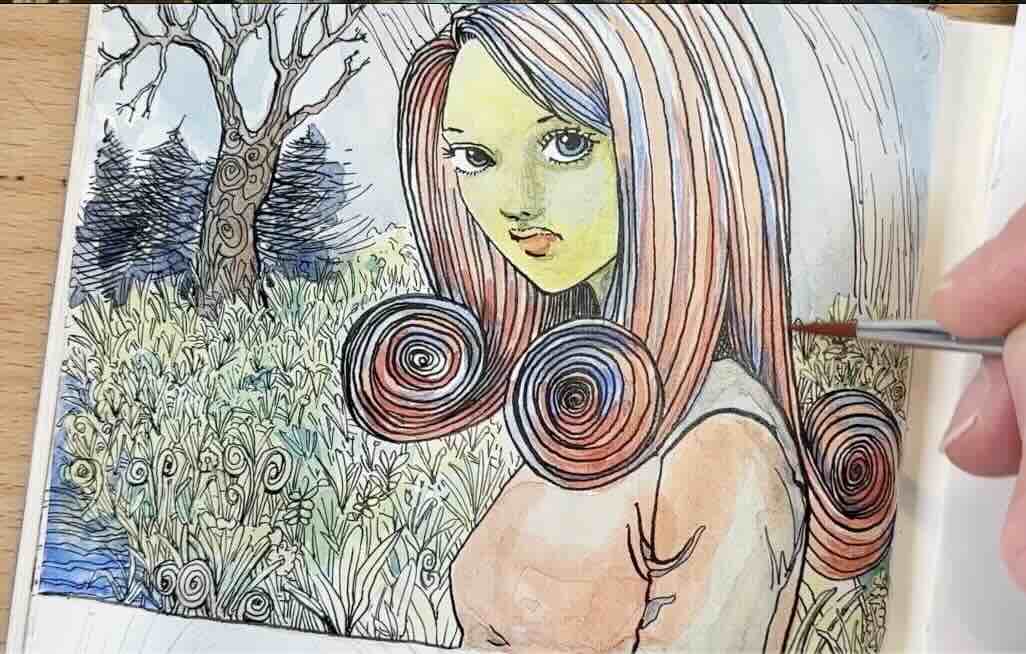
Even without any knowledge of the story, because of the washed-out primary colours, and how her hair is rendered from neatly spaced parallel lines into tense, gyrating buns, you just know that spirals are bad.
Then you start to notice spirals in the scenery, and get goose bumps.
It’s all in the contrast
Junji Ito plans these genius effects to engage your imagination into whatever fearsome concoction lurks on the next panel.
He achieves this through the use of contrast.
Like in some spots, he uses these beautiful open edges in the outlines, which gives the line work a subtle finesse and is intuitively attractive.
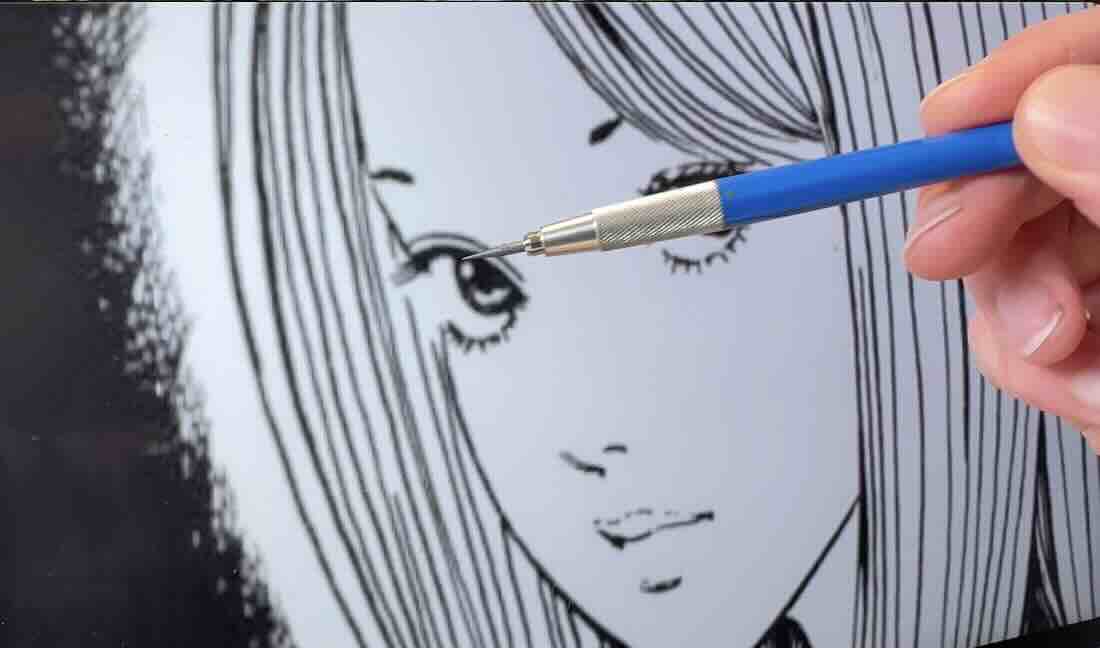
Then anything intended to incite terror is rendered in explicit detail with mad marks, so you can’t look away from nightmare images now seared into your brain.
This master has an incredible body of work. You’ll find a few of his books, some videos, and all the tools I used in these studies in the resources section below.
Thank you to my YouTube viewers for suggesting Junji Ito for a feature, perfect for a Halloween-themed study.
Resources
🎥 Videos ↓↓
Great, Strange, & Terrible Manga

📗 Books ↓↓

🧰Tools ↓↓